
The village church is dedicated to St Mary the Virgin. There has almost certainly been a place of worship in East Haddon since the 11th century – the Domesday Book documents the existence of a priest.
The original church was built on this site in the latter part of the 12th century, the only remains of that building being the capitals of the pillars which support the chancel arch, and the stone font. The font bears the figure of a man holding two winged serpents under his arms. This is believed to be an early sculptor’s portrayal of Christ crushing the serpent’s heads, and in so doing securing the redemption of mankind.
The first church was completely rebuilt towards the middle of the 14th century on the lines of the present building, except that over the porch was a “pervaise” or priest’s chamber. The west door, the tower arch, and the three clerestory windows at the top of the south wall of the nave are typical of the 14th century gothic style.
In the north wall of the nave is a blocked up doorway, which probably owes its existence to there being one of the three medieval manor houses in the village situated to the north of the church. The door was probably in use up till the middle of the 19th century, but by 1877 it had been blocked up.
In 1878 the old box pews were removed and replaced by the present oak pews, and in the same year the arch which accommodates the organ was added. The present organ was installed in 1928 by Taylors of Leicester, and rebuilt in 1995.
The church has 6 bells, which are of particular interest. You can see full notes on these by clicking below. The tower was rebuilt in 1673 following a partial collapse.
The tower also houses a clock, which was built in 1863 by Moores of London, a renowned clock maker of the time, and installed in 1863 by Messrs J Cram of Daventry. In 2011 the original hand crank winding system was upgraded to an automatic electrically powered winding mechanism, which also incorporates a regulator to maintain good time keeping.
In 1889 there was an outbreak of diphtheria in the village, resulting in 17 deaths. In the same year, because of a suspected link between the disease and possible contamination from earlier burials the churchyard was closed, and a new cemetery opened in 1891.
Church records give us the names of all clergy since 1237, and a full list can be found below
Recent years have seen continuing work to maintain the fabric of the church.
St Mary’s today…….
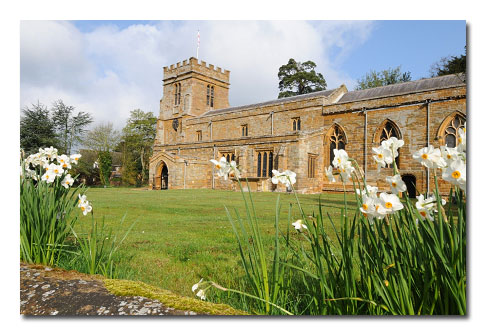
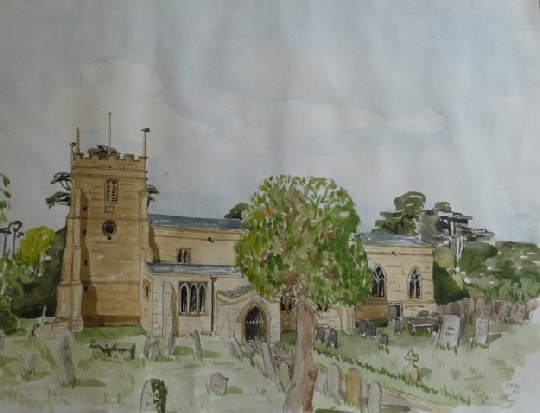
and as depicted in a painting by Mrs Sylvia Blacklee, in 1961. Notice the spires are still on the tower, and the headstones still in the yard.
East Haddon Church tower houses a fine ring of 6 bells.
These are of historical importance in the world of campanology; records show that on 31st December 1756, the first ever recorded peal of 5040 changes on 5 bells was rung at East Haddon by
“a Society of Old Ringers, each man aged upwards of 50 years of Age rang 5040 changes, which takes up several Peals of five bells; and completed in three Hours and ten Minutes.”
The press cutting from the time does not reveal their names.
The bells and their origins are:
Treble Taylors of Loughborough, 1928.
2nd Hugh Watts, Leicester, 1621
3rd Hugh Watts, Leicester, 1621
4th Hugh Watts, Leicester, 1621
5th Abhraham Rudhall, 1731
Tenor Hugh Watts, Leicester, 1621
The treble weighs 5 cwt., the tenor weighs 15cwt (745kg).
Each bell carries an inscription, cast into the metal when the bell was made.
EAST HADDON CLERGY
While the Domesday Book documents the existence of a priest in East Haddon, the available list of clergy dates from 1237.
RECTORS:
1237 Hugh le Stanford
1240 Wiliam de Houton
1294 Hugh de Wyneford
1301 Laurence de Belgrave
1342 Peter de Belgrave
1350 Thomas Knapetoft
1369 Thomas de Pery
VICARS:
1370 William Hardy
1370 John Waryn de Buckby
1390 John Gurry
1395 John Etton
1402 John Botheby
1405 Hugh Humberston
1413 Thomas Leche
1441 John Cok
1444 Thomas Leche
1456 John Chappell
1457 William Garrardde
1477 Robert Lewyn
1502 Thomas Ormeston
1511 Thomas Barkar
1517 Robert Goodeall
1524 John Fox
1546 Robert Mowyer
1553 Christopher Segeswyk
1595 Henry Bourne
1650 James Dutton
1681 James Blockley
1702 Edward Whitmell
1743 George Clerke
1748 Anthony Chester
1769 Theophilus Goodfellow
1782 William Lucas Holden
1814 John Sykes Sawbridge
1830 Edmund Smyth
1854 William Locock
1869 William Horton
1871 William Poulter McKesy
1889 Jas. Housemayne de Boulay
1898 Vincent Leatherdale
1907 William Robinson
1916 Walter Roseveare
1922 George Pitter
1936 Folliot Sandford Keysell
1945 Cyril King
1952 Frederick Thorman
1962 Frank Towndrow
1967 Bernard Fernyhough
1977 Peter Rowe
1988 Joseph Doty
1993 James Richardson
1997 David MacPherson
2002 Chris Goble
2010 Sue Kipling